
Scottish Myths & Legends
Selkies, kelpies and the makers of dreams.
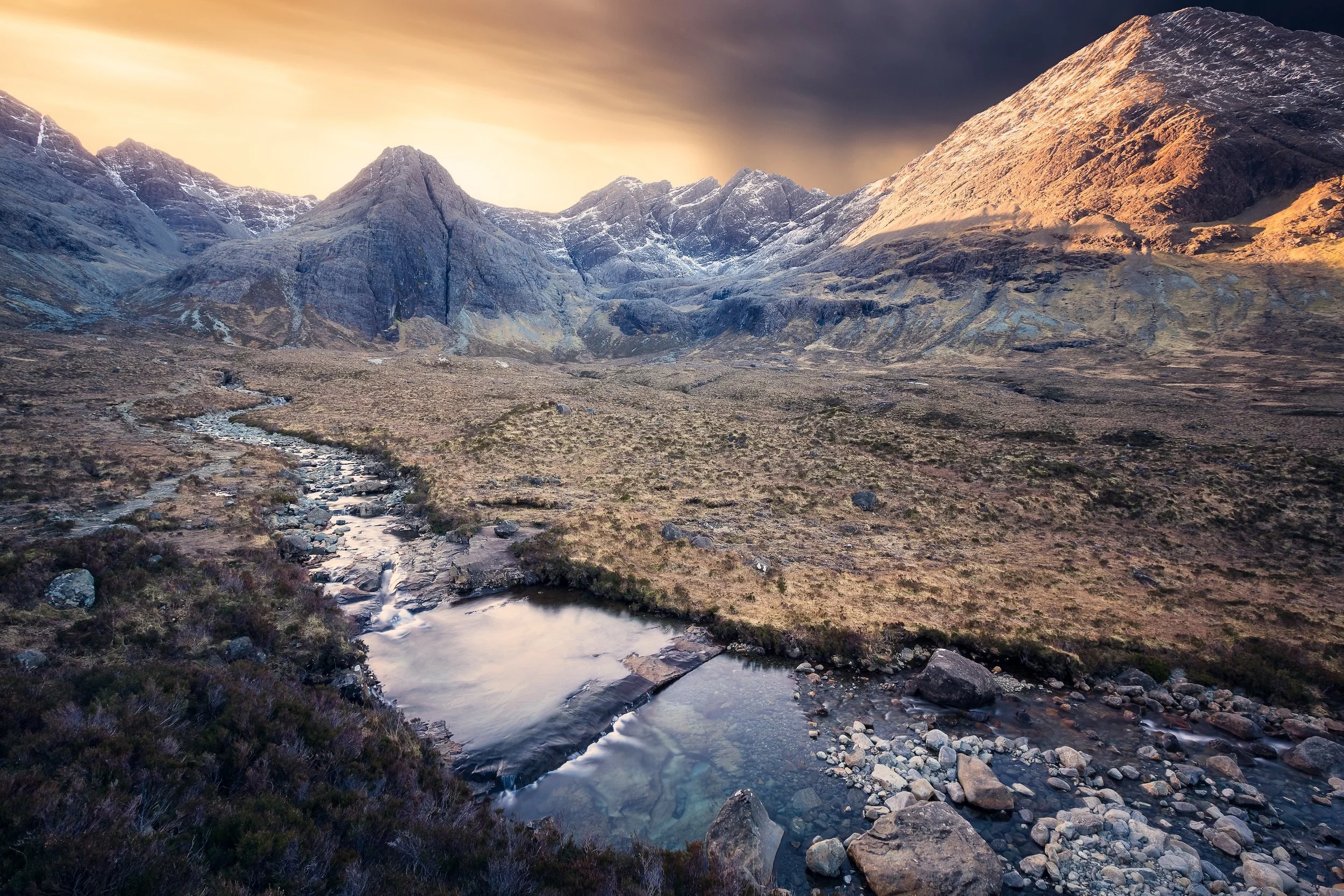
From the jagged peaks of Skye to green border glens, Scotland’s stories are as sublime as the landscape itself.
The Queen of the Fairies gallops through the forest. Seal-women dance on moonlit shores. A prince seeks the fabled Battle of the Birds while severed heads sing at the edge of the world.
From comic tales to impossible quests, these stories speak of a world where every loch, moor and seashore is a doorway to the Otherworld.
“One of the best collections I have ever read”
— Fiona C NicDhùghaill, Scottish Storytelling Centre
“Terrific traditional tales… imaginations are sure to soar”
— Celtic Life International
Scottish Myths & Legends is a collection of traditional stories retold by Daniel Allison, a Scottish oral storyteller. It includes 24 stories from places such as Skye, Orkney and the Scottish Borders.
The stories feature mythical creatures and characters including selkies, kelpies, the Cailleach and Tam Lin.
You can order this book from independent bookstores, Amazon and Audible.
The Makers of Dreams
Long ago, on a bright autumn morning upon the Island of Skye, a group of girls set out to go blaeberry picking. They left their village with their baskets in hand and made for the foothills of the black, sharp-peaked Cuillin mountains.
Though all the girls were laughing, singing and smiling, there was one among them who laughed more joyfully and sang more sweetly than the others, for she gave her heart to every moment that she lived. She was determined to pick the freshest, sharpest and juiciest berries to bring home to her mother. When they reached the foothills of the Cuillins, she stopped singing and focussed on her search.
Picking berries was like hunting to her; she tracked her prey like a hungry wolf. She roved the hills, moving higher and higher, unaware that she could no longer hear laughter or singing. The grass grew thinner beneath her feet, the air colder.
After a long time, she stood and stretched out, then paused.
She looked around.
What had happened? It was morning when they started their search. Now the sun was sinking, her friends were nowhere to be seen and she was… where was she?
She didn’t know where she was; but she knew one thing. The foothills of the Cuillins were far below her; she was among the mountains themselves.
She shivered. Wrapping her cloak more tightly about her, she tried to convince herself that all would be well. It wasn’t easy. It was evening, and she was alone and lost among the Cuillins. All her life, she had heard tales of these mountains: of giants, dark druids, monsters and cannibals. The stories all agreed on one thing: those who got lost in the Cuillins never found their way out again.
As the dim dusk descended, the wind stirred and blew in a mist from the sea. Within moments she could barely see her hand in front of her face, let alone look for a path. She stood there, helpless, growing colder and colder.
Voices sounded through the mist.
Spectral shapes appeared around her. They surrounded her.
The girl laughed as figures appeared out of the mist. It was not giants or monsters that surrounded her. It was a herd of deer.
The hinds pressed forward, nosing at her, clearly curious as to what she was doing there.
All of a sudden, they froze. Their ears pricked up.
The hinds set off. Some of them nuzzled and nudged at the girl, making it clear that she was to come with them. She did so, since she had no better plan. They made their sure-footed way through the mist and the gathering dark. The girl followed them as they led her along narrow, winding trails, up and up into the high mountains.
In the day’s last hour, the mist cleared. High up among the peaks of the mountains, the hinds led the girl into a hidden glen.
It was the most beautiful glen she had ever seen. Waterfalls tumbled down between every peak, little streams criss-crossed the grass and bright flowers adorned the meadows. A rocky buttress looked west over the sea, and she fancied she could see all the way to the edge of the world.
At the far end of the glen was a cave. Firelight flickered within.
The herd led the girl to the cave. She waited outside, peering in as the lead hind entered.
Inside the cave, on seats of stone, sat an old woman and an old man. They weren’t simply old; they were ancient, as ancient as the mountains. Between them and their fire was a pool, which they stared into, unblinking.
The lead hind approached the old woman. It spoke to her in soft grunts while the old woman listened, nodding, still staring into the pool.
As the hind went on speaking, the old woman’s head shot up. She stared at the girl.
Slowly the old woman got to her feet. She shuffled over to the girl and said, ‘What business brings you to the mountains?’
‘I was out picking blaeberries, and I got lost,’ said the girl. She held out her basket towards the old woman. ‘You’re welcome to have some. May I stay here for a night?’
The old woman smiled, revealing broken teeth. She turned around and walked over to the old man, who listened as she spoke, nodding, not looking up as he gazed into the pool.
Again, the old woman shuffled over to the girl.
‘No,’ she said. ‘You may not stay here a night.’
The girl’s face fell.
‘But—’
‘You may not stay here for a night. A year and a night, you may stay. I am old, and my work wearies me. Help me with the hinds and the gathering of herbs, and earn your place by our fire.’
To that, the girl agreed.
* * *
Time rode by in its spiralling circle. The girl did what was asked of her, helping the old woman with her work, sharing her life. Not once did the girl ever leave the glen.
Every day, the old woman took a stool and bucket and went out to meet the hinds in the meadows. She sat on the stool, the hinds came to her and she milked them. Once the bucket was full, she carried it back to her cave.
Later in the day, she walked through the glen, picking herbs. She plucked meadowsweet and thyme to scatter in the deer milk. Afterwards, she heated the milk and herbs in a pot over the fire, making a thick cheese called crowdie. This was the old woman’s life.
The girl went everywhere with the old woman, watching her at her work until, one day, she took over the old woman’s work. Thus, the old woman’s life became the girl’s life.
When the crowdie was ready it was given to the old man, who sat day and night by the pool.
‘What is that pool?’ the girl asked the old woman one day.
‘It is the Pool of Life,’ the old woman answered.
Once he had the bucket, the old man would take a lump of crowdie in his hands. Staring into the depths of the pool, he would fashion the crowdie into shapes and figures.
‘What are those shapes he makes?’ asked the girl one evening.
‘They are dreams,’ said the old woman. ‘We are the Makers of Dreams.’
Every evening, the old man took the bucket to the rocky buttress overlooking the western sea. As the sun scattered gold over the mountains, he held up his works in his hands, one by one.
In his right hand, he held up dreams of love and joy, hope, bravery and brotherhood. As he held up each dream, a bird would fly down and take it from his hand. Eagles, falcons and kestrels came, and even little wrens. They took the dreams and carried them out into the world, gifting them to sleepers the world over.
In his left hand, the old man held aloft dreams of hatred, envy, distrust and jealousy. These dreams were borne away and sown among sleepers by kites, crows and all the birds of the battlefield; a dark harvest they would wait to reap.
* * *
One morning, the old woman roused the girl from her sleeping place by the fire.
‘It is time for you to leave,’ said the old woman. ‘A year and a night have passed. You have served us well, and your reward awaits you.’
The girl was sad to hear this, for she had grown to love her life there. She would miss spending nights by their fire, gazing into the shifting and shimmering waters of the Pool of Life. Yet she did miss her family, her friends and her home.
The old woman called the lead hind in and spoke to her in a whisper. Once she had finished, the hind led the girl out of the cave.
The herd gathered and led the girl out of the glen, down a path she had never noticed before. Down they went, ever down. In the evening, they reached a cove at the foot of the mountains, facing west.
‘Thank you,’ said the girl. ‘I’ll miss you all.’ She hugged each of the hinds and made to leave, but they crowded around her. They wouldn’t let her leave. Every one of them was looking west.
She followed their gaze. Raising her hand to shield her eyes from the sun, she saw what they were looking at. Rowing towards her, in a little coracle, was a man.
The man beached his craft and climbed out. He was young, perhaps a little older than her, and wore a golden torque around his neck.
He was a prince.
The Prince walked over to her. The hinds parted and bowed to him as he bowed before her.
‘My Lady,’ he said, ‘I have crossed the ocean in search of you, and at last I have found you.
‘I come from Tir Na Nog, the Land of the Ever Young, which lies further west than West. Every night, for a year and a night, I have dreamed of you. I have seen you milking hinds, gathering herbs and gazing into the Pool of Life.
‘As I dreamed of you, I fell in love with you. I ask you now to come with me, over the sea, to Tir Na Nog, and marry me. Be my bride, rule over our people and teach us the meaning of dreams.’
The girl had fallen in love with the man before he even spoke. Though she longed to see her family and friends, her time by the pool had taught her wisdom. Her destiny lay over the waves.
Again, the girl said goodbye to the hinds. She turned, took the Prince’s hand and waded into the water. They climbed into the coracle and crossed the sea to Tir Na Nog. She lives there now, and she will live there until the end of days. 1
1. This is a favourite among Scotland’s storytellers, for obvious reasons. Besides its beauty, it has the feeling of a gateway into the ancient past. It was collected by Otta Swire and features in her 1952 collection, Skye: The Island and Its Legends, which went on to influence Neil Gaiman. The Cuillins are named after the Irish hero Cuchulainn, who trained as a warrior on Skye with the witch queen Scathach.
Tir Na Nog, the mythical island mentioned here, is commonly referred to in Irish legends but less so in Scotland. It is a place where everything is perfect, where no one gets old or speaks ill of another. Tir Na Nog lies behind Valinor, the undying land which the elves sail to in The Lord of the Rings. Ossian, Fionn mac Cumhaill’s son, spent many years there.